Do you have a question for us? You may find an answer to your question in our FAQ section below.
If you can’t find the answer you are looking for, please contact us by filling in the contact form.
We are happy to help!
Knives
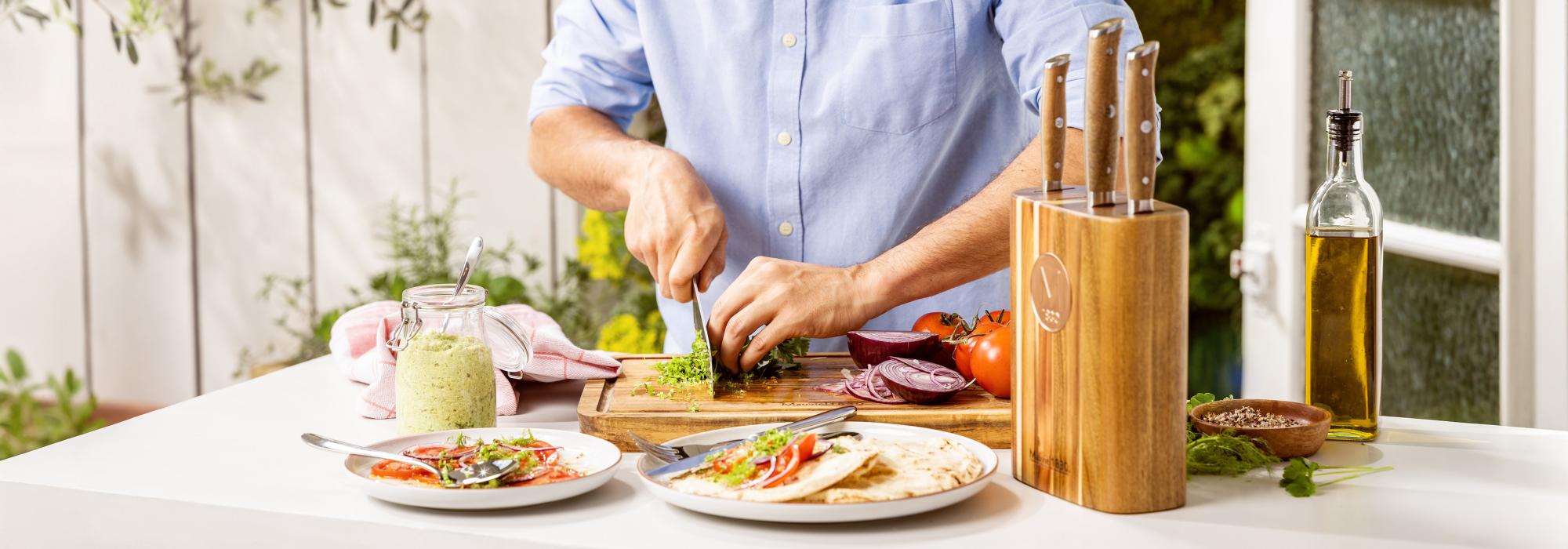
The Mauviel1830 knives are made out of stainless steel with riveted acacia wood handle.
Yes. The Mauviel1830 knife handles are made from acacia wood, which means that all patterns are natural and therefore unique.
Always be careful with knives! Knives must be sharp. As a result, some simple safety instructions apply. Following these significantly reduces the risk of injury:
- Leave your knives in sight: Always leave the knife on the work surface with the handle facing you and make sure it can not accidentally fall. Never place the knife under a dish towel or other items to prevent unintentional injuries. Be sure to always hold the knife by the handle and always pass a knife with the handle facing the recipient.
- The right knife: Always use the right knife: vegetables, fruit, meat, fish, cold cuts and bread all have different textures and sizes. Therefore, there is a specific knife for each of these foods.
- Cut away from the body: Always cut away from the body. This will prevent you from getting injured if the knife accidentally slips.
- Falling knife: Never try to catch a falling knife! This can cause serious injuries.
- Wash your knives one by one: Be aware that you are handling sharp knives when you wash them. Do not put your knives in the sink or in a bowl of water. It's best to wash them under running water immediately after use, then dry them thoroughly. Wipe knives clean from the handle to the tip and from the back of the blade to the cutting edge: never touch the cutting edge. Never wash or dry more than one knive at once.
- Storage: Knives must be stored safely to avoid injuries and damage to the blade. A knife block meets these two requirements perfectly. The Mauviel1830 wooden knife block is specially designed to meet all safety requirements.
- Children: Keep sharp knives out of the reach for children. Store your knives somewhere safe.
- Are my knives sharp enough? Never run your fingers over the cutting edge even to test the sharpness!
- Heat sources: Never place your knife on or near a hotplate or other heat source to avoid damage and burns.
- Read the care, use and safety instructions on the packaging before unpacking the knife.
- Wash the knives before you use them for the first time with warm water, a suitable detergent and a soft sponge or cloth. Dry them carefully.
- Do not put your knives in the dishwasher.
- Be careful when using or cleaning the knife.
No. Putting your knives in the dishwasher may damage your wooden handle or stainless-steel.
Hand washing is gentler on the steel of the knives.
During a cycle in the dishwasher, the blades of the knives may come into contact with other objects. This friction can damage the objects and blunt the blades + damage the acacia wood.
Additionally, if dirty knives are left in the dishwasher for a while, food residue can cause damage to the blades.
The wrong amount of detergent or rinse aid in the machine, in turn, can cause rust stains.
- Mauviel1830 knives are made exclusively for cutting vegetables, fruit, meat, fish and bread. Do not use them on bones or on frozen food. Preferably use a wooden cutting board to prevent damage to the cutting edge. Doing so your knive will keep sharp longer.
- The knife should be cleaned and dried immediately after each use. To extend the life of your knife, we recommend always washing it by hand. Use warm soapy water and a soft sponge or dishcloth. Dry them carefully. If the knife is in contact with liquids or other substances for too long, rust spots may appear. The dishwasher can also cause corrosion on the blade. If rust forms, the rust can be removed with vinegar essence, concentrated citric acid or a food-safe rust remover, for example.
- If you do not use your knives daily, it is advisable to grease the blade very lightly with sunflower oil or ballistol, for example. Always clean the knife before use.
When using your knives frequently, the knives can become blunt over time. Use a knife sharpener or whetstone to make blunt knives sharp again.
- Knive sharpener: Gently pass the blade through the slot for several times
- Whetstone: the whetstone shouldhave a higher hardness than the knife.
- Caution: Serrated knives can not be sharpened.